The Following are the reviews the author has received, classified by believed background. Further comments would be well received.
Reviews from Non-technical Readers
If I’d seen it in a bookshop, the cover would have made me stop and look: the intriguing picture of Oxford and The North York Moors. The arrival of Rhan in Oxford, her loneliness, eccentricity, isolation, until working with soul-mate George, again pulls the reader into her world very quickly, so we feel interested in her blossoming socially and academically.
Although I’m aware of climate change, I am a factual layman, BUT the scientific elements in the book have not only been accessible but very interesting and thought-provoking.Rowing is another area I had no experience or knowledge of, but Rhan’s involvement in the rowing club, her fast learning of various moves in a variety of conditions have been not only descriptive but very exciting. With waves and rivalry mounting, I really felt the cold, the wet and the tired limbs.
The fast narrative, the clear descriptions, academic arguments, and Rhan whom I like, have kept me wanting to read more. Un-put-downable. MB
I was fascinated by the intimacy of the characters, and their intimacy with the locations (Oxford and Yorkshire). BM
I’m on page 115. Rhan is freaking out over what she’s read on the Internet and suspects some kind of conspiracy of silence. Meanwhile her relationship with George is getting closer though nothing explicit has actually occurred, at least not in print. I’m really enjoying it.
I love the descriptions of Oxford and university life. The sinister threat is building: that this ancient and beautiful world, physical and intellectual, will be blown away is horrifying. GP
I took Greenhush away as a holiday read and enjoyed the story as well as being challenged by some of the ideas. DR
Reviews from Readers in Education
I’m reading Greenhush – I am about 60% of the way through – and what an excellent read it is.
I’ve just finished reading Greenhush and enjoyed it – especially the brilliant surprise twist at the end. I spent most of the book thinking:
- are tutors really so closed minded that they would remonstrate with an undergraduate for raising a legitimate question with a visiting lecturer
- what on earth has rowing got to do with climate change – it seemed a pretty strange way of maintaining the reader’s interest…until the last few pages. RF
It has got me thinking about what we teach though, and what we could do better to teach the required engineering survival skills. I’ve started reflecting on having a day or two day activity of some sort for all years. MC
Reviews from Engineers and Scientists
A really good book YB
Having just read your novel I am writing to congratulate you on producing such an interesting and thought-provoking work. All aspects were fascinating: the vivid descriptions of university life, the pressures of competing at the top class in sport, and of course the cogent and compelling arguments about the vital need to control and then reduce global warming. A thoroughly good, and inspiring, read. AS
Finished reading this on the train to work this morning. I would highly recommend anyone having a read. It’s a great novel in its own right, heavily intertwined with the theme of global warming and the impending climate crisis to help raise awareness of the outcome of inaction on reducing carbon emissions. We’re already seeing crop failures, record temperatures, extraordinary flood events on a local and international scale.
Written by engineer Robert Thorniley, it isn’t overly technical. It’s accessible to all and an enjoyable read – even my Mum finished it before me and thoroughly enjoyed it!
It’ll now be passed on to the next person in the office, and I’ll encourage anyone to pick it up. It will certainly make you think. DOM
Thank you for the link to Robert and his book. What a fascinating man and intriguing that he was involved in making the London barrage, which as he says, used to be used 3 times a year and is now used 50 times a year. We really have made a mess of the planet. It keeps me busy!! Enormous thanks, warm wishes. PL
Greenhush is very hard hitting. Really enjoying it-you have very effectively put across the stupidities of our current world through the questions of a young student. Brilliant idea to dramatise the concrete lecture. What is concerning since you wrote the book, is that the solutions being (currently) proposed to address climate change are purely aimed at allowing us to carry on “business as usual”, no real efforts to reduce (greenhouse gas emissiions). SG
I have read Greenhush and I enjoyed it.- I had the opportunity to read the digital copy of the book. MD
I found Greenhush both an entertaining and enlightening read. The story a young lady called Rhan is one of success against the odds in life, love and sport as a Syrian refugee and female Engineering student at Oxford. The book brought to life comparisons between cultures across the planet and the ages which provided a richness to the story as well as food for thought on how life changes over time. Rhan’s newly acquired obsession with modern living took me along with her on a thought-provoking journey. All in all I found this rich story compelling. Once I started reading I literally couldn’t put it down! PM
Newspaper Review (D&S)
Conservation engineer and author Robert Thorniley, took me on an unexpected tour of Sheepwash, to show me this beautiful part of the North York Moors in a whole new light. It is a key setting for his book “Greenhush”.
Despite the mizzly rain which spreads its fingers across the tops of t
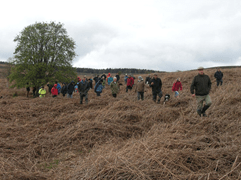
he hills in waves, blotting out light and soaking us through in seconds – even the sheep looked fed up – I was excited about what I was about to see.
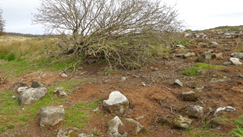
We walked from the main car park, Robert striding ahead across the top of the small rounded glacial hill between the car parks, which I had walked countless times before, not knowing it was a Bronze Age burial ground. Robert pointed his stick towards the ground showing me collections of stones which were the burial mounds – so many of them – and then there were two possible Bronze Age houses on the top as stone circles, hardly visible to the untrained eye.
As the hill across the road cleared, he pointed to the wall of a bronze-age dyke, which was 80 metres long when first discovered, and through Robert’s further research, is now more than 800 metres in length. To the right, a possible neolithic village by a fallen tree.g Co
Robert is a conservation accredited engineer, a director at Structural and Civil Consultants Ltd, who works on structural aspects of historic buildings in need of repair, such as York City Walls and the historic Bars, Ravensworth Castle and Castle Howard. He also designed the exhibition space at Danby Visitor Centre.
He designs with historical materials rather than steel and concrete, and for modern structures he uses local British hardwoods. During this year, the company won an award for its work on Swinton Castle, from the Institution of Structural Engineers, Northern Branch, for an unusual sustainable project.
“The engineers went into the woods to select the trees for the new estate office,” he says. “They used sycamore and beech with larch joists– the thinnings taken from the estate. So little is known about timber with minimal research, and yet so much is known about concrete and steel.”
Robert is also a climate change activist who lectures on climate risks at universities and to professionals. He was the spokesperson for world engineers at Paris COP Climate Talks, the former regional chair for the Institution of Civil Engineers (ICE), and a former member of ICE Climate Change Taskforce
He has poured his passion into a novel, for which he gathered information over 15 years. He describes Greenhush as a textbook disguised as a novel. It is a fictional story which highlights the factual risks of the denial of a heating planet, and the dangers the younger generation will face. He decided to write it after speaking in Paris at The COP Climate Talks, realising that he needed to get the message out there, believing the growing problem was not being addressed by professionals or people in power.
Scientists Warning Europe, say about the book: “This interesting and enjoyable tale is interwoven with pertinent information about global warming and concludes with an important potential solution.” A quotation on the first page reads: “The young will recognise that the old generation have knowingly ruined the planet.”
His book launch raised money for Oxfam’s Syria appeal – much of the book is seen through the eyes of a young female Syrian refugee who believes she has found a safe life in the western world.
Robert spent his childhood in Osmotherley, especially on the moors around Sheepwash, where he would cycle to daily to enjoy nature and explore the landscape. His father was a county councillor, and his mother a teacher at Ingleby Arncliffe school. Educated at Ampleforth and then at Oxford where he was able to study all aspects of engineering, he decided on the one where he could be in the fresh air.
“I worked on the Thames Barrier, which was my first job, ” he says. “I didn’t expect to enjoy London, but I did. I was commuting to work in little boats, going from pier to pier, but working there made me realise something was happening to our climate. Another alarm call happened during my visit to a glacier in New Zealand, where the dates from 1948 to 1975 showed where the glacier used to be over the years. I investigated. I realised this was not a conspiracy theory, but a reality. I started to campaign but was making little headway, hence the birth of the book.”
Robert began to write papers and give talks. “People need to start worrying about the future for the younger generation,” he says. “Huge savings in time and money can often be made by using lightweight green materials instead of steel and concrete, which often has huge overruns in budget. If the government is serious about levelling up, why not ration carbon and those who use less can sell to those who use more?”
As Robert stands in the rain, he expresses hope that his book will raise awareness and get the message out there.
“Even on this beautiful landscape, where each week I seem to discover new findings, ” he says sadly, “there are major environmental changes following both the spraying of the bracken and the drying out of the soil. This has exposed so much more archaeology than was previously visible.”
Greenrush is available on Amazon and through York Publishing services Ltd on http://www.yps-publishing.co.uk.Tel: 01904 431213
Jan Hunter
 Greenhush Novel